Skip to content

Transcription

00:07

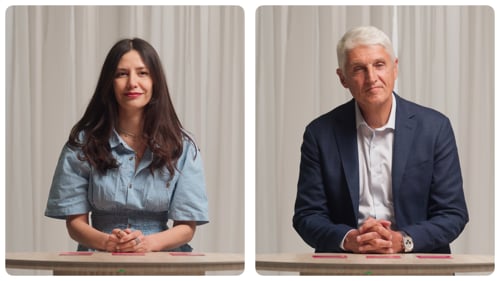
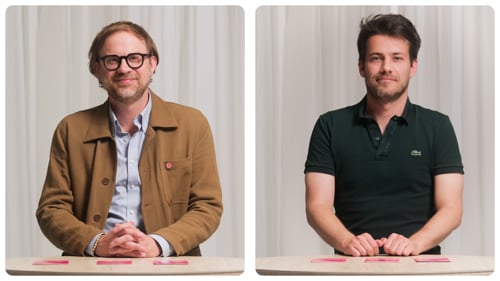
Hello, I'm Joan Balaña, Sales Director at Factorial from the Partners ecosystem, and I’m here to talk about intelligence artificial intelligence applied to human resources.

00:16

My name is Pau Garcia-Milà. I am the CEO and co-founder of Founderz,and I have three children.

00:21

And I'm more concerned about the human resources for the next generation than for myself.

00:31

Hi, Pau and Joan.Here's how On the Deck works: First, you'll answer a question without knowing what your partner will say, and then you'll have the chance to exchange ideas and explore your answers in greater depth.

00:43

Let's get started.Question 1: Why do companies lose candidates before hiring them?

00:50

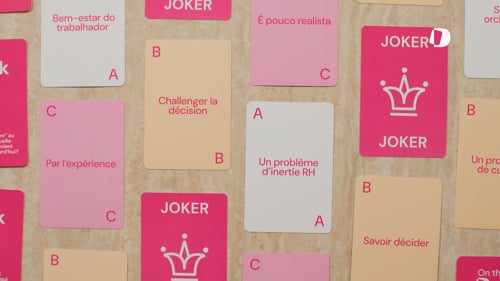
A) Offers that aren't convincing.B) You misjudge talent.

00:54

C) You filter too late, or D) The Joker.There are many nuances.

01:00

I'm going to go with The Joker.I'm going to choose A.

01:12

How are you, Joan?How's it going, Pau?It's good to see you.

01:15

Me too.I was thinking of A, let's say It's like "taking the bullet," as they say in English—which is like taking the blame for the company.

01:26

As for the other two, filtering too late is partly their fault and partly a misjudgment Talent is like breaking up with someone and saying, “It’s not you, it’s me.” I mean, come on, you're the one cutting, you know?

01:40

The thing is, I misjudged his talent.I know, but you're telling me no.

01:44

Exactly.You have data in Factorial; you know things.

01:48

Yeah, since I keep them all, I'd say it has a lot to do with the urgency of signing players.

01:53

In other words, we—at least in the teams that We manage this process and enjoy staying in constant contact with candidates in order to so that when the time comes to choose someone, having that our talent pipeline, or if we come across any talent we like It's very important to be able to justify the internal headcount and accommodate it.

02:14

So why do I choose the joker?Because when we're not in a rush to hire, where we fall short is in the C,we, in filtering too late.

02:23

In other words, since it's not urgent, we're putting it on the back burner for now and not addressing it really potential talent who might be a good fit.

02:32

I don't know if you guys do this too, Pau—looking for talent constantly, whether you need to or not.

02:38

There's one thing I really like—it fits in with what you're saying,The thing is, they say that a company starts to move beyond the startup phase after more than a jungle of chaos, and to grow and become a little more organized when they shift from hiring quickly and firing slowly to hiring Take your time and say goodbye quickly.

02:59

In other words, some companies end up conducting two interviews and they hire one or both of them because they have an urgent need and then When there is a situation, a relationship where a person doesn't fit in at a company, on a project,It's dragging on, and in the end, this is also the worst-case scenario for everyone,including the person.

03:20

So, in the end, when you turn around and say, “No,is that I want to take my time finding the right person for "I have a job and I have time to do it," but in the end, there's just no way out,It's just a matter of giving it a try, because in the end you'll find the talent that's right for you.

03:36

So, in my case, misjudging talent is something which I think we can all do—even if it's late.

03:45

But my feeling is that AI where it will have the greatest impact on these processes is precisely to make it harder to find the human side,because everyone is going to come to you with the perfect resume,because the AI is going to do it. It's like, "I speak perfect English." And then: "Let's switch to English." "I don't know." What will set us apart from AI is the human element.

04:10

Sure.And do you think AI could lead us to exclude candidates who actually have that human side of us that we're not prioritizing?

04:18

Or what would that human side mean to you?Is it more related to corporate values?

04:23

We are not currently using AI in human resources.I have to admit that traditionally, when I was in charge of interviewing the people who were about to come in and so on, I tried to imagine, to picture day-to-day work with that person.

04:40

Not so much in the specific tasks I would have, but in my normal day-to-day life,in a celebratory situation, but also in a crisis, and see if they fit in the way we used to work.

04:54

Sure, sure, sure.So maybe the Joker does make sense after all.

05:01

Question 2: In what areas can AI most improve employees' day-to-day work?